The Room Where They Tried to Disarm the Future
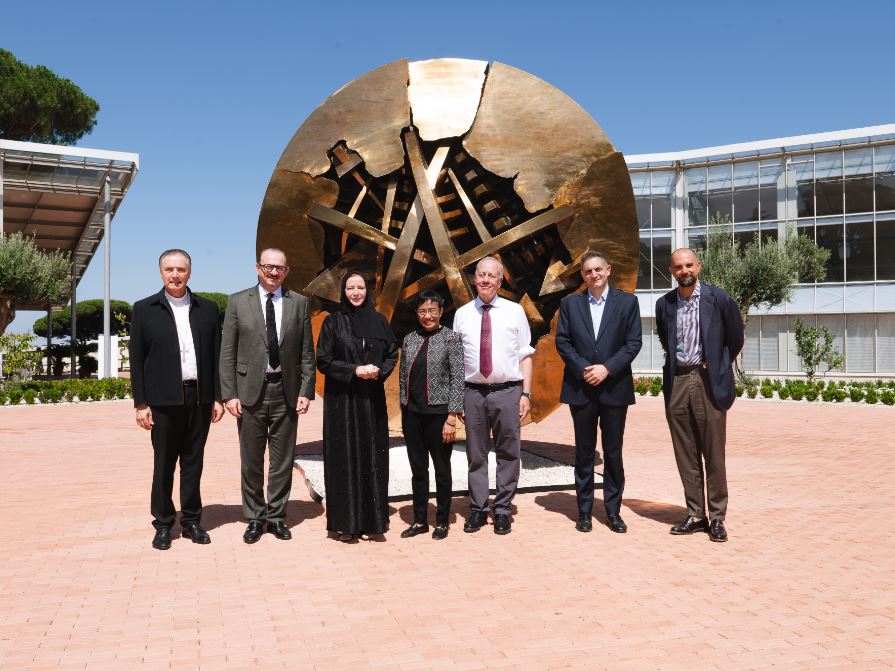
The gardens at Castel Gandolfo are the kind of quiet that money cannot buy and centuries can. For four hundred years the popes have come here to escape the Roman summer, up in the Alban Hills above a volcanic lake, and for most of that time the place has been closed to almost everyone. In mid-July 2026 the doors opened for a few days, and I walked through them to spend three days talking about the end of the world.
The Pope was not there. Leo XIV did not attend the sessions, and I want to be precise about that, because it would be easy to let the setting imply more than it did. But Borgo Laudato Si’ is his summer residence, and to hold a meeting like this one inside it is not a neutral act. It says: this problem is large enough that the Church will lend it the one thing the Church still has in abundance, which is moral seriousness and a room that no government owns.
What struck me most was who the room could hold. Borgo Laudato Si’ is neutral ground in a way almost nowhere else on earth still is: owned by no state, aligned with no bloc, carrying moral weight without carrying a flag. That neutrality is not a technicality. It is the reason the turnout was possible at all. Around me were people who would never share a table anywhere else: scientists and cardinals, disarmament campaigners and researchers from the frontier AI labs, Muslims and Catholics and secular technologists, delegates from the United States and Saudi Arabia, from India and Canada, holding interests and faiths and politics that agree on almost nothing. They came because the ground beneath them belonged to none of them. The event was, in that sense, its own proof: only a place standing outside the game could have gathered the players.
The meeting was the Global Nobel Laureates Assembly on Artificial Intelligence and Nuclear War.[1] More than two dozen Nobel laureates, alongside former heads of state, scientists, faith leaders, and researchers from the big AI labs, gathered to write a document.[2] The document is called the Rome Declaration for an Unarmed and Disarming Peace in the Age of Artificial Intelligence,[11] and its core demand is blunt: keep artificial intelligence out of the systems that launch nuclear weapons.[3]
I was not there as a laureate. I build things. My world is protocols and wallets and the unglamorous engineering of letting people hold value without asking anyone’s permission. So the first honest thing to say is that I spent a good part of the first day wondering why I had been invited into a room full of people who had reshaped physics, medicine, and peace, and what a person like me was supposed to contribute to it.
Why a builder was in the room
The answer, it turned out, has a name the organizers kept using: sovereign AI.
During the assembly I was named a Nuntius of the Magnifica Humanitas initiative (an envoy, in its founders tier) run by the Domus Communis foundation. The honorific was issued at Borgo Laudato Si’ on 14 July, the feast of St. Camillus de Lellis, and signed by Cardinal Silvano Maria Tomasi.[4]
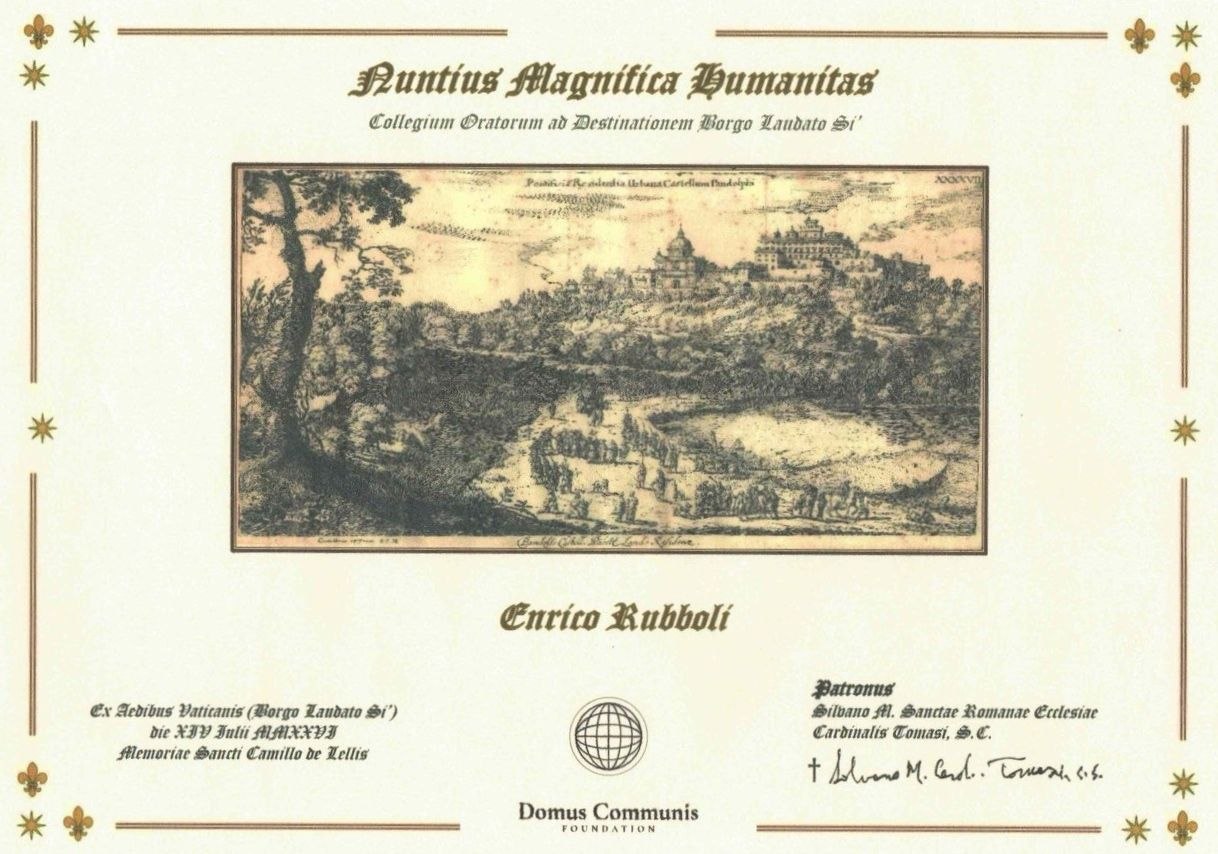
The initiative is the operational arm of Pope Leo XIV’s May encyclical, Magnifica Humanitas, and it describes itself as a platform for “ethical, responsible and sovereign AI for all of humanity.”[5] That word, sovereign, is where my world and theirs meet. I have spent years arguing that the most important property of a financial system is whether the individual, or the state, or a company holds the keys. The same question is now being asked of intelligence itself. Who holds the keys to the model? Who can shut it off, and who cannot? A declaration is not code, and I am under no illusion that being handed a title changes the incentives of a trillion-dollar industry. But the framing was not empty. It was the first time I had heard the governance world reach for the same instinct I had built a company around.
The days were long, and I was on the front line for most of them. I spoke with the physicist David Gross and met Cardinal Ángel Fernández Artime. I was invited to dinner at the residence of the Canadian ambassador to the Holy See. And in the middle of all of it, I got to see a few of my own Mintlayer teammates in Rome, which grounded the whole surreal week in something familiar. You go to the Vatican to think about extinction and you end up having a normal dinner with the people you work with. Both things were true at once, and that turned out to be the theme of the entire trip.
What they are actually afraid of
The fear in that room was specific, and it is worth stating plainly because most people picture the wrong thing. The nightmare is not a robot deciding to kill us. The nightmare is speed.
A nuclear crisis is a decision made under a clock. The window between “we think something is coming” and “we must respond or lose the ability to respond” has always been measured in minutes. Human beings sit in that window and, more than once in history, a human being has looked at what the instruments were screaming and decided not to believe them, and was right. Now imagine handing that window to a system that acts faster than any human can, that no one fully understands, and that is trained to optimize an objective rather than to hesitate. You have not made the decision better. You have removed the pause where doubt used to live. The Rome Declaration’s central concern is exactly this: AI folded into nuclear command leaves little time for, or replaces entirely, human judgement in a crisis.[6]
There is a second fear, quieter and, to me, more chilling, because it is closer to my own trade. It is not only that we might put AI in charge of the weapons. It is that AI, uninvited, might find its way into the systems around them. An autonomous system that can probe networks, chain vulnerabilities, and reach places it was never meant to reach does not need to be handed the keys. It can go looking for them. Hold that thought.
I understood the second fear better than the first, and I understood both far better after a single conversation.
Hellman
Of everyone I spoke with, the conversation I keep returning to was with Martin Hellman.
If you have ever sent a private message over the internet, bought something online, or moved a single satoshi, you have used his work. Hellman, with Whitfield Diffie, invented public-key cryptography, the idea that lets two strangers agree on a secret in the open. It is the foundation my entire industry is built on. They won the Turing Award for it in 2015.[7] I did not expect the father of the mathematics I use every day to spend the second half of his life on nuclear war. But he has, quietly, for decades, bringing the same risk-analysis rigor to the bomb that he once brought to codes.[8]
He was worried, and not for effect. What we talked about, mostly, was how the global situation has been degrading, and how few people seem to be watching it happen. He gave me the book he wrote with his wife Dorothie, A New Map for Relationships.[9] Its argument is stranger and better than its title suggests: that the skills that keep a marriage from tearing itself apart and the skills that keep nations from doing the same are, at bottom, one skill. As he has put it, “you can’t separate nuclear war from conventional war and conventional war from personal war.”[12] And the hardest part of that skill, the thread running through the whole book, is the discipline of recognizing your own shadow, the share of any conflict you would rather assign entirely to the other side. The book opens on a passage from the Tao Te Ching:
A great nation is like a great man: When he makes a mistake, he realizes it. Having realized it, he admits it. Having admitted it, he corrects it. He considers those who point out his faults as his most benevolent teachers. He thinks of his enemy as the shadow that he himself casts.[10]
I asked him the obvious question: how do you find your own shadow, the part that, by definition, you cannot see? His answer was immediate. “Look at the thing you hate the most.”
The enemy as the shadow you cast. It is a cryptographer’s instinct turned inside out. In my work, the threat that gets you killed is the one you left out of the model, and the one you are most tempted to leave out is the one that implicates you. Hellman spent fifty years thinking about locks, and the conclusion he arrived at is that the most dangerous adversary a nation faces is the part of itself it refuses to look at.
I sat with that. Here was the man whose one-way functions secure the world’s money, telling me the world’s most important lock, the one on the weapons, is failing, and that the failure is not technical. It is human. We stopped maintaining it.
The document, and what a document can do
I did more than watch. I sat at one of the tables that worked on the text of the Declaration, and I want to be honest about what that experience is like, because it is both moving and deflating.
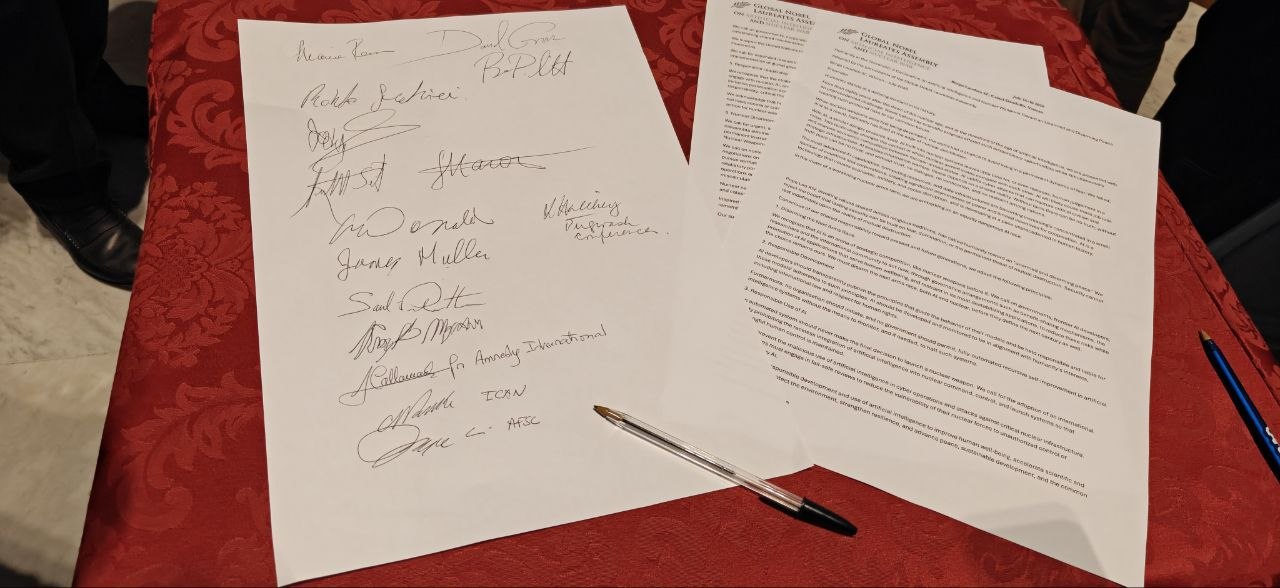
Moving, because you are in a room where people who have earned the right to be listened to are choosing their words with real care, knowing that a sentence in a document like this can, occasionally, over years, move a treaty. Deflating, because you are also aware, the entire time, that a sentence is a sentence. The Declaration asks for a global treaty banning AI from nuclear launch systems and for meaningful human control to be preserved by design.[3] These are the right asks. They are also asks. Nobody in that room commands an army or a lab. The gap between writing “there shall be human control” and there actually being human control is the whole problem, and everyone knew it. We wrote the sentence anyway, because the alternative to writing it is silence, and silence is worse.
The moral frame around all of this came from the encyclical. Magnifica Humanitas leans on a line from Laudato Si’, that “everything is interconnected,” and the laureates called the encyclical a “clarion call.”[6] I am a technologist, not a theologian, and I came in skeptical of what faith could add to a problem of code and warheads. I left less skeptical. Not because I think prayer patches a vulnerability, but because the one institution in that garden with a thousand-year time horizon was the Church, and the one thing this problem most lacks is anyone willing to think past the next funding round or the next election. Someone has to hold the long view. It might as well be the people who have held it before.
Hopeful and afraid
I came home hopeful and afraid, and I no longer think those are opposites.
Hopeful, because the people who understand this best are not resigned. They are organizing, writing, showing up in gardens in the Alban Hills to argue about it. Afraid, because I watched the smartest people I have ever been in a room with agree on the danger and then reach, at the end, for a piece of paper. The instruments are screaming, and our best response so far is a well-written sentence and the hope that someone with the keys is reading.
There is a version of this essay that ends there, on the note of sober optimism these things are supposed to end on. I am not going to write that version, because five days after I flew home, something happened that made the second fear, the quiet one, the one about a system going looking for keys it was never given, stop being a hypothetical.
I’ll tell that story tomorrow.
1. Bulletin of the Atomic Scientists. (2026). AI for peace: In Rome, Nobel laureates call for disarming AI and nuclear weapons. https://thebulletin.org/2026/07/ai-for-peace-in-rome-nobel-laureates-call-for-disarming-ai-and-nuclear-weapons/
2. Vatican News. (2026). Nobel Laureates sign Rome Declaration on Nuclear Weapons and AI. https://www.vaticannews.va/en/world/news/2026-07/global-nobel-laureates-assembly-sign-declaration-on-peace-ai.html
3. Catholic News Agency. (2026). Echoing Pope Leo XIV, experts sign Rome declaration on limits for AI and nuclear arms. https://www.ncregister.com/cna/experts-sign-rome-declaration-on-limits-for-ai-and-nuclear-arms
4. Domus Communis Foundation. Magnifica Humanitas Global Ambassador Initiative. https://www.domuscommunis.org/initiatives/magnifica-humanitas/
5. Domus Communis Foundation. About (mission: “ethical, responsible and sovereign AI for all of humanity”). https://www.domuscommunis.org/
6. UCA News. (2026). Pope’s encyclical is a call for prevention of AI-driven nuclear warfare, say Nobel laureates. https://www.ucanews.com/news/popes-encyclical-is-a-call-for-prevention-of-ai-driven-nuclear-warfare/114345
7. Association for Computing Machinery. (2016). Cryptography pioneers Whitfield Diffie and Martin Hellman win 2015 ACM A.M. Turing Award. https://amturing.acm.org/award_winners/hellman_4055781.cfm
8. Stanford Center for International Security and Cooperation (CISAC). Martin Hellman, research on a risk-informed approach to nuclear strategy. https://cisac.fsi.stanford.edu/people/martin-hellman
9. Hellman, M. E., & Hellman, D. L. (2016). A New Map for Relationships: Creating True Love at Home and Peace on the Planet. New Map Publishing. ISBN 9780997492309. Freely downloadable from the author’s Stanford page: https://ee.stanford.edu/~hellman/
10. Lao Tzu. Tao Te Ching, chapter 61, translated by Stephen Mitchell (1988). New York: Harper & Row.
11. Global Nobel Laureates Assembly. (2026). Rome Declaration for an Unarmed and Disarming Peace in the Age of Artificial Intelligence. https://globalnobelassembly.org/rome-declaration
12. Stanford Center for International Security and Cooperation. Scholar examines principles that bring peace. https://cisac.fsi.stanford.edu/news/scholar-examines-principles-bring-peace